
An occupational hazard of working in a laboratory includes unexpected chemical reactions when one is cleaning up after some procedures.
I have learned, early on, that bleach makes brown paper towels turn yellow and cell pellet dark orange.
Today, however, I was cleaning up a waste beaker after purifying DNA from a gel like I had many times before, but to my surprise the yellow solution turned lilac when I added soap and water!
I don't actually know what chemicals were in the beaker, as I was using a kit labeled with the oh-so-helpful names of "Buffer QG," "Buffer PE," and "Buffer EB" (the company wants to keep the ingredients secret so we don't buy chemicals in bulk and make our own kits but instead pay $450 per box). It is quite likely that the basic pH of the soap and water combined with the mix of other liquids (I know there was at least some isopropanol and ethanol in there) caused the color change, but I cannot be sure.
My high school chemistry teacher would have a fit if she found out that the lab safety rules of her lab are mostly disregarded here (No goggles? Gasp! No aprons? Goodness me!). Fortunately, we handle the chemicals (most of them, except for ethidium bromide [which we handle in quantities no greater than 0.5µL], are not harmful) in such tiny quantities that it does not matter that much (Oh nooooo, I spilled 5µL of buffer! What ever shall I do?)
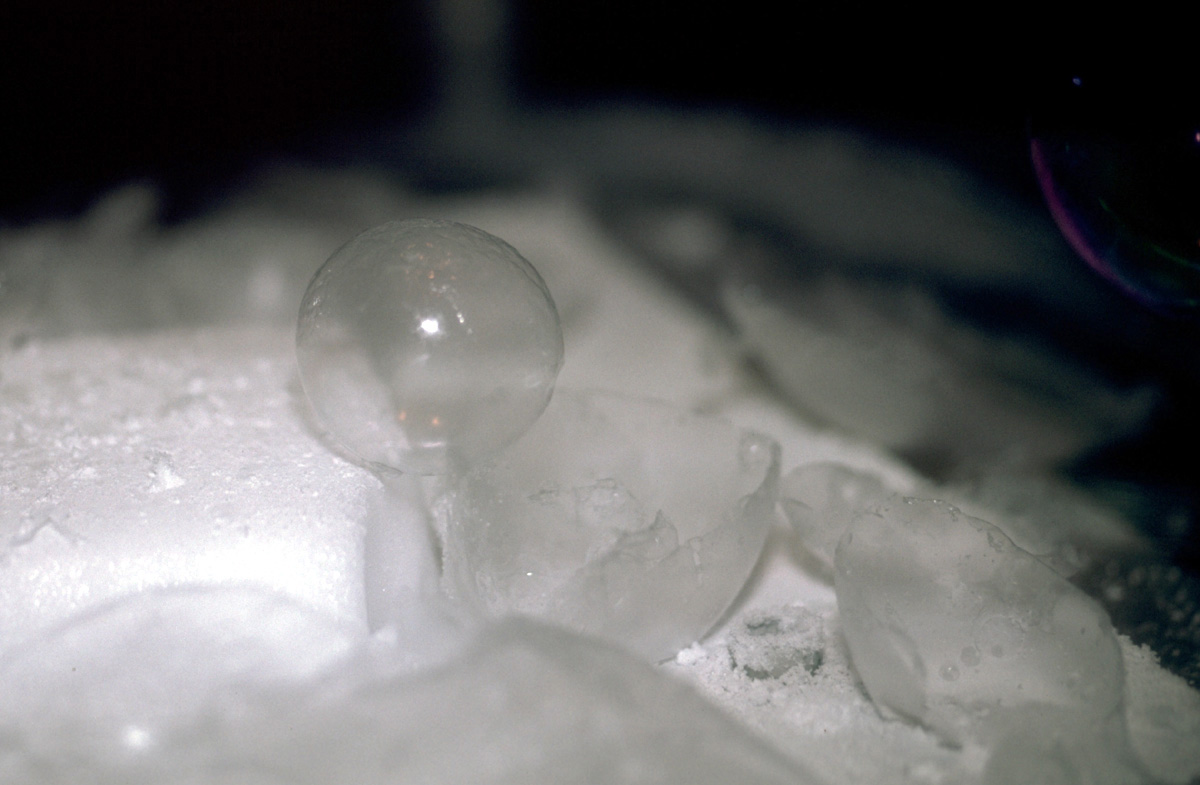
It's somewhat of a far cry from the idea of chemistry I had when I was a child (exploding things in Erlenmeyer flasks), but it's still rather nice to be able to play in a lab. The next time we are expecting a delivery of frozen chemicals (and consequently the box of dry ice they are shipped in) I will bring a bottle of bubble soap to play with during lunch break.
I have learned, early on, that bleach makes brown paper towels turn yellow and cell pellet dark orange.
Today, however, I was cleaning up a waste beaker after purifying DNA from a gel like I had many times before, but to my surprise the yellow solution turned lilac when I added soap and water!
I don't actually know what chemicals were in the beaker, as I was using a kit labeled with the oh-so-helpful names of "Buffer QG," "Buffer PE," and "Buffer EB" (the company wants to keep the ingredients secret so we don't buy chemicals in bulk and make our own kits but instead pay $450 per box). It is quite likely that the basic pH of the soap and water combined with the mix of other liquids (I know there was at least some isopropanol and ethanol in there) caused the color change, but I cannot be sure.
My high school chemistry teacher would have a fit if she found out that the lab safety rules of her lab are mostly disregarded here (No goggles? Gasp! No aprons? Goodness me!). Fortunately, we handle the chemicals (most of them, except for ethidium bromide [which we handle in quantities no greater than 0.5µL], are not harmful) in such tiny quantities that it does not matter that much (Oh nooooo, I spilled 5µL of buffer! What ever shall I do?)
It's somewhat of a far cry from the idea of chemistry I had when I was a child (exploding things in Erlenmeyer flasks), but it's still rather nice to be able to play in a lab. The next time we are expecting a delivery of frozen chemicals (and consequently the box of dry ice they are shipped in) I will bring a bottle of bubble soap to play with during lunch break.


No comments:
Post a Comment