
Prepare to be shocked, astounded, astonished, surprised, startled, dumbfounded, bedazzled, and otherwise flabbergasted:
The experiment actually worked. Well, it wasn't mine, but it worked. I went into lab today expecting to stay long hours to repeat my transformation, which hadn't worked (but then again, so did 95% of the entire class, so I didn't feel too bad about it), and instead found myself standing in front of a boggled Doctor who had just discovered a plate that had worked and moreover happened to be the very gene I was working on.
You see, we work as a team. Four or five people are assigned one gene and all work on it until someone's experiment works, then all move on to the next step using the products of that experiment. That way, you don't waste time or chemicals, you go much faster, people working on the same gene are on the same page, and overall it is easier to manage. Plus, if (in my case) something went horribly, horribly wrong somewhere upstream (but where?), you don't have to worry about it and start all over again like I was afraid I would have to.
So, on the Monday after Spring Break, I will go to the lab and begin the second leg of my journey, repeating the same process on a different gene fragment, all the wiser from my previous mistakes and failure.
I am actually very much looking forward to it!
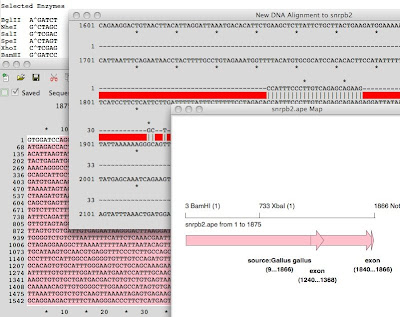
Also, I am learning how to use a program called ApE, an acronym which looks much fancier than its given name (A plasmid Editor) but is otherwise very spiffy and makes me feel like a real scientist
This is good news, good news indeed.
Plus, Seminar yesterday was about biochips (scroll through the presentation, it's fascinating), which, in addition to being some of the coolest science I have ever been exposed to, combines biology, chemistry, physics, math, and computing. I will never look at muffins, dominoes, or Cheerios every again (ever wondered why Cheerios made flower shapes in a bowl of milk? Well, they use this principle FOR SCIENCE. How awesome is that?)
The experiment actually worked. Well, it wasn't mine, but it worked. I went into lab today expecting to stay long hours to repeat my transformation, which hadn't worked (but then again, so did 95% of the entire class, so I didn't feel too bad about it), and instead found myself standing in front of a boggled Doctor who had just discovered a plate that had worked and moreover happened to be the very gene I was working on.
You see, we work as a team. Four or five people are assigned one gene and all work on it until someone's experiment works, then all move on to the next step using the products of that experiment. That way, you don't waste time or chemicals, you go much faster, people working on the same gene are on the same page, and overall it is easier to manage. Plus, if (in my case) something went horribly, horribly wrong somewhere upstream (but where?), you don't have to worry about it and start all over again like I was afraid I would have to.
So, on the Monday after Spring Break, I will go to the lab and begin the second leg of my journey, repeating the same process on a different gene fragment, all the wiser from my previous mistakes and failure.
I am actually very much looking forward to it!
Also, I am learning how to use a program called ApE, an acronym which looks much fancier than its given name (A plasmid Editor) but is otherwise very spiffy and makes me feel like a real scientist

This is good news, good news indeed.
Plus, Seminar yesterday was about biochips (scroll through the presentation, it's fascinating), which, in addition to being some of the coolest science I have ever been exposed to, combines biology, chemistry, physics, math, and computing. I will never look at muffins, dominoes, or Cheerios every again (ever wondered why Cheerios made flower shapes in a bowl of milk? Well, they use this principle FOR SCIENCE. How awesome is that?)


1 comment:
Well I've learned something; if not that which I should have learned from this posting. I now know that Cheerio is a brand of breakfast cereal created on June 19, 1941 and marketed by the General Mills cereal company of Golden Valley, Minnesota. Gosh.
I tried to understand the presentation, honestly. But I've decided that life is too short so I shall do that which I've done for the previous years of my life: leave science to scientists. This ignores the question from Uni days of whether politics and sociology and the like are arts or sciences.
But if I ever see a Cheerio and float it in milk I shall think of you.
And 'spiffy'! Wow. I haven't heard that word since.... Well, I can't remember when.
Verification = sques. Love that.
Post a Comment